
Jurabibliotek Logo Jurabibliotek Logo
Log ind
    Indstillinger
    Tekststørrelse
    Tegnafstand
    Linjeafstand
    Tema
      • Forside og kolofon
      • Preface
      • Overview and index (PDF version only)
    • Part 1. Introduction to the legal system
      • Chapter 1. The legal system and the sources of law (Page 25 – 35)
        • 1. Introduction
        • 2. The sources of law
          • 2.1. Legal substance
            • 2.1.1. Interpretation of the law
            • 2.1.2. Declaratory and mandatory legal provisions
            • 2.1.3. Conflicts of law, etc.
            • 2.1.4. Publication of legislation, etc.
          • 2.2. Administrative regulations
            • 2.2.1. Executive orders
            • 2.2.2. Circulars
            • 2.2.3. Guidelines
          • 2.3. Case law
          • 2.4. Custom
          • 2.5. Nature of the relationship
        • 3. The legal system
          • 3.1. Private law and public law
          • 3.2. Property rights
          • 3.3. Civil procedure, bailiff’s law, and probate law
        • 4. Legal capacity and capacity to act
          • 4.1. Legal capacity
          • 4.2. Capacity to act
      • Chapter 2. EU law (Page 37 – 58)
        • 1. The Treaty Basis
          • 1.1. History
          • 1.2. Treaty of Lisbon
        • 2. EU law
          • 2.1. General
          • 2.2. Specifically on the Treaty freedoms
            • 2.2.1. Free movement of goods
            • 2.2.2. Free movement of labour
            • 2.2.3. Right of establishment
            • 2.2.4. Freedom to provide services
            • 2.2.5. Capital and payments
        • 3. EU institutions
          • 3.1. The European Parliament
          • 3.2. Council of the European Union
          • 3.3. The European Council
          • 3.4. European Commission
          • 3.5. Court of Justice of the European Union
          • 3.6. The European Patent Court
          • 3.7. European Central Bank
          • 3.8. Court of Auditors
        • 4. The legal acts
          • 4.1. Regulations
          • 4.2. Directives
          • 4.3. Decisions
          • 4.4. Recommendations and opinions
        • 5. The legislative procedure in the EU
          • 5.1. Adoption of legal acts
            • 5.1.1. The general decision-making procedure
          • 5.2. Implementation at national level
          • 5.3. Publication of EU legal acts, etc.
      • Chapter 3. Overview of the administration of justice (Page 59 – 75)
        • 1. Introduction
        • 2. Civil and criminal justice
        • 3. Organisation and jurisdiction of the courts
          • 3.1. Ordinary and special courts. Appeals Board
            • 3.1.1. City courts
              • 3.1.1.1. Bailiff’s court
              • 3.1.1.2. Probate court
            • 3.1.2. High Courts
            • 3.1.3. Supreme Court
            • 3.1.4. Special courts
            • 3.1.5. Appeals Board
          • 3.2. Subject-matter jurisdiction of the courts (jurisdiction)
          • 3.3. Territorial jurisdiction of ordinary courts (protection of property)
            • 3.3.1. International competence
          • 3.4. Functional competence
            • 3.4.1. Appeal
            • 3.4.2. Retrial
        • 4. Parties to the proceedings. Basic procedural principles
          • 4.1. Subject of the complaint
          • 4.2. Adversarial principle
          • 4.3. Negotiation and disposition maxim
          • 4.4. Assessment of evidence
          • 4.5. Burden of proof
        • 5. Enforcement and recognition actions. Legal force
          • 5.1. Danish court decisions
            • 5.1.1. Case procedure in a debt collection case
          • 5.2. Foreign court decisions
        • 6. Settlement
        • 7. Arbitration
      • Chapter 4. Private international law (Page 77 – 86)
        • 1. Introduction
        • 2. Sources of law
        • 3. The conflict of law rules
          • 3.1. Function and division
          • 3.2. Freedom of contract and limitations therein
          • 3.3. The individualized method
          • 3.4. Uniform assessment
    • Part 2. Contracts and Tort
      • Chapter 5. Contracts (Page 89 – 131)
        • 1. Introduction
          • 1.1. Historical development
          • 1.2. The Danish Contracts Act – the most central concepts
        • 2. Mutually imposing contract vs. gift contracts
        • 3. Danish law does not normally set formal requirements for contracts
        • 4. Conclusion of contracts – offer and acceptance
          • 4.1. Offers
            • 4.1.1. Promise
            • 4.1.2. Conditions of a promise
              • 4.1.2.1. The promisor must impose a burden
              • 4.1.2.2. The declaration must express a decision
              • 4.1.2.3. Addressee
              • 4.1.2.4. Submission
              • 4.1.2.5. The declaration must have come to the attention of the recipient
          • 4.2. Acceptance
            • 4.2.1. Acceptance deadline
              • 4.2.1.1. Section 2 of the Danish Contracts Act
              • 4.2.1.2. Section 3 of the Danish Contracts Act
              • 4.2.1.3. Rejection of offer
            • 4.2.2. Delayed acceptance
            • 4.2.3. Non-conforming acceptance
            • 4.2.4. Designation of the co-contractor
            • 4.2.5. Complaints
            • 4.2.6. Waiver of acceptance
        • 5. Formation of contracts in other ways
          • 5.1. Adoption of standard contracts
          • 5.2. Special contract procedures
          • 5.3. Quasi-contracts
          • 5.4. Obligation resulting from inaction
        • 6. Interpretation and fulfillment of contracts
          • 6.1. Introduction
          • 6.2. Interpretation
            • 6.2.1. Interpretation points
            • 6.2.2. Interpretation rules
            • 6.2.3. Interpretation of standard contracts
          • 6.3. Gap-filling
          • 6.4. Contract and interpretation regarding gap-filling-evidentiary
        • 7. Invalidity of promises
          • 7.1. Introduction and definition
          • 7.2. Strong and weak grounds for invalidity
          • 7.3. Positive legal provisions on invalidity
            • 7.3.1. Minor
              • 7.3.1.1. Lack of legal capacity generally results in invalidity.
              • 7.3.1.2. Exceptions to the general rule
              • 7.3.1.3. Legal effects of invalidity due to incapacity
            • 7.3.2. Mental illness, etc.
            • 7.3.3. Counterfeit and counterfeiting
            • 7.3.4. Duress
              • 7.3.4.1. Violent compulsive duress and mechanical duress
              • 7.3.4.2. Other duress
            • 7.3.5. Fraud
            • 7.3.6. Exploitation
            • 7.3.7. Discrepancy between will and declaration
              • 7.3.7.1. Section 32, subsection 1
              • 7.3.7.2. Section 32, subsection 2
              • 7.3.7.3. Reservatio mentalis
              • 7.3.7.4. Pro forma contracts
            • 7.3.8. AFTL § 33 – the rule of “general honesty”
            • 7.3.9. Contracts Act § 36 – the general clause
            • 7.3.10. Content deficiencies
              • 7.3.10.1. Promises that are contrary to decency
              • 7.3.10.2. Promises that are against the law
              • 7.3.10.3. Employment clauses
              • 7.3.10.4. Violation of standard terms
          • 7.4. Other situations in which a promise is (possibly) not binding
            • 7.4.1. Supplement to the rule in Contract Act § 30
            • 7.4.2. Supplement to the rule in the Contracts Act § 33
            • 7.4.3. Failed assumptions
          • 7.5. Consumer Contracts Act
          • 7.6. Legal effects of invalidity
            • 7.6.1. Inter partes
            • 7.6.2. To the creditors of the pledgee
            • 7.6.3. To the promisee’s business acquirers
        • 8. Third-party promises
      • Chapter 6. Agency law (Page 133 – 151)
        • 1. Introduction
        • 2. Messengers
        • 3. Power of attorney
          • 3.1. Types of powers of attorney – power of attorney with and without special existence
          • 3.2. Power of attorney without special existence
          • 3.3. Power of attorney with special existence
          • 3.4. Authorization vs. power of attorney
          • 3.5. The legal relationship between the principal and the third party
            • 3.5.1. Power of attorney invalid
            • 3.5.2. Death or bankruptcy of the principal
            • 3.5.3. The agent exceeds his/her authorization/power of attorney
            • 3.5.4. The agent’s promise to a third party is invalid
            • 3.5.5. Power of attorney revoked
          • 3.6. The legal relationship between the agent and the third party
          • 3.7. The legal relationship between the principal and the agent
        • 4. Future powers of attorney
          • 4.1. Establishment of a future power of attorney
          • 4.2. Implementation of the power of attorney
          • 4.3. Legal effect, supervision, and termination of the power of attorney
        • 5. Commission agents
          • 5.1. Legal position vis-à-vis third parties
            • 5.1.1. Obligation to third parties
            • 5.1.2. Ownership of the goods held by the commission agent
            • 5.1.3. Ownership of the claim against a third party
            • 5.1.4. Ownership of money paid by third parties
            • 5.1.5. The commission agent’s resale of the principal’s goods
          • 5.2. The legal relationship between the principal and the commission agent
        • 6. Commercial agents
          • 6.1. Introduction
          • 6.2. Does a commercial agent have a power of attorney?
          • 6.3. The parties’ duty of loyalty
          • 6.4. The commercial agent’s right to commission
          • 6.5. Non-competition clauses
          • 6.6. Termination of the agency contract
          • 6.7. To what extent may the rules of the Commercial Agents Act be deviated from?
          • 6.8. The legal relationship between the commercial agent and a third party
        • 7. Sales travelers
        • 8. Brokers
        • 9. Unrequested business management (negotiorum gestio)
      • Chapter 7. Tort Law (Page 153 – 173)
        • 1. Introduction and delimitation
        • 2. Function of tort law
        • 3. Compensation and insurance
        • 4. Basis of responsibility
          • 4.1. Liability for negligence
          • 4.2. Responsibility in employment relationships
            • 4.2.1. Employer’s responsibility
            • 4.2.2. Employee responsibilities
          • 4.3. Strict liability
            • 4.3.1. Statutory strict liability
            • 4.3.2. Special attention to liability for motor vehicles
            • 4.3.3. Strict liability without legal basis
          • 4.4. Presumption of liability
          • 4.5. Liability of children and the insane
          • 4.6. Objective grounds for exemption from liability
            • 4.6.1. Right of self-defense
            • 4.6.2. Acts of necessity
            • 4.6.3. Consent
            • 4.6.4. Unrequested business management
        • 5. The injured party must have suffered a loss.
          • 5.1. Not all losses are compensated (in full)
          • 5.2. Indirect losses
          • 5.3. The injured party’s duty to limit losses
          • 5.4. Are the injured party’s claims affected by the third party’s performance?
        • 6. Causation and foreseeability
        • 7. Injured party’s participation
        • 8. Multiple tortfeasors
      • Chapter 8. Product liability (Page 175 – 183)
        • 1. Introduction
        • 2. Regulatory basis
        • 3. Product liability as developed by case-law
          • 3.1. Product
          • 3.2. Defect
          • 3.3. Product damage
          • 3.4. Liability basis
          • 3.5. Limitation
        • 4. Product Liability Act
          • 4.1. Product
          • 4.2. Defect
          • 4.3. Product damage
          • 4.4. Liability
            • 4.4.1. Liability for producers
            • 4.4.2. Responsibility of intermediaries
            • 4.4.3. Multiple parties liable for damages and recourse
            • 4.4.4. Contributory and comparative negligence
          • 4.5. Limitation
    • Part 3. Sales and transport contracts
      • Chapter 9. Sales (Page 187 – 252)
        • 1. Introduction. The concept of purchase
        • 2. The Danish Sale of Goods Act
          • 2.1. Nature of the law and exemptions
          • 2.2. Scope of application of the law
          • 2.3. Different types of sales agreements
            • 2.3.1. Species and genus sales
            • 2.3.2. Commercial sales and civil sales
            • 2.3.3. Consumer sales rules
        • 3. Exchange of the parties’ obligations
          • 3.1. Time for performance of the parties’ obligations
          • 3.2. The concept of delivery
          • 3.3. Place of delivery
            • 3.3.1. The buyer’s performance (the sales price)
            • 3.3.2. Seller’s performance (the item of sale)
              • 3.3.2.1. “Pick-up sale”
              • 3.3.2.2. “Delivery sales”
              • 3.3.2.3. “Shipment sales”
              • 3.3.2.4. Consumer sales
          • 3.4. Performance against performance
            • 3.4.1. The general rule (SGA § 14)
            • 3.4.2. Shipment sales (SGA §§ 15, 16 and 71)
              • 3.4.2.1. Payment against delivery of the goods themselves
              • 3.4.2.2. Payment against documents
          • 3.5. The risk of accidental loss and deterioration of the item being sold
            • 3.5.1. The concept of risk
            • 3.5.2. More about the risk rules
              • 3.5.2.1. The main rule in SGA section 17, subsection 1.
              • 3.5.2.2. Exceptions to the rule that the time of delivery is decisive
        • 4. Seller’s performance
          • 4.1. Introduction
          • 4.2. The scope of the seller’s obligations – main obligations and ancillary obligations
            • 4.2.1. Yield of the object of sale (SGA §§ 18‑20)
            • 4.2.2. Leeway for margin sales (SGA § 66)
          • 4.3. Delay
            • 4.3.1. The right to require specific performance (performance in kind)
            • 4.3.2. Right to terminate the sale
            • 4.3.3. The right to claim damages
              • 4.3.3.1. The seller’s liability for selling species goods
              • 4.3.3.2. Liability of the seller of generic goods
              • 4.3.3.3. Scope of compensation
              • 4.3.3.4. Buyer’s obligation to complain
          • 4.4. Defects
            • 4.4.1. Introduction
            • 4.4.2. More about the concept of defects
            • 4.4.2.1. Not all errors are defects
              • 4.4.2.2. The assessment of defects
              • 4.4.2.3. The decisive moment
            • 4.4.3. Remedies in case of defects
              • 4.4.3.1. Proportionate or appropriate price reduction
              • 4.4.3.2. The right to terminate the contract
              • 4.4.3.3. Right to demand defect-free performance (replacement, subsequent delivery and remedy/repair)
              • 4.4.3.4. Buyer’s right to compensation
            • 4.4.4. Expiration of the rights to remedy defects
              • 4.4.4.1. Remedying the deficiency
              • 4.4.4.2. Complaints rules (SGA §§ 51‑54 and 81-85)
              • 4.4.4.3. Other matters
          • 4.5. Legal defects
            • 4.5.1. Unlawful possession
            • 4.5.2. Lack of right of disposal
        • 5. Buyer’s performance
          • 5.1. Scope of the buyer’s performance
            • 5.1.1. The actual purchase price
            • 5.1.2. Special rule for trade purchases
            • 5.1.3. Costs, etc.
            • 5.1.4. Other rules on pricing the seller’s service
          • 5.2. Default by the buyer
            • 5.2.1. The concept of delay
            • 5.2.2. Seller’s remedies
              • 5.2.2.1. Seller’s right to maintain the purchase
              • 5.2.2.2. Seller’s right to terminate the contract
              • 5.2.2.3. Seller’s right to compensation
              • 5.2.2.4. Seller’s obligation to make complaints
        • 6. Mora creditoris. Termination of contracts, etc. General complaint rules
          • 6.1. Mora creditoris
            • 6.1.1. Seller’s mora creditoris
            • 6.1.2. Buyer’s mora creditoris
            • 6.1.3. The legal effects of the buyer’s mora creditoris
              • 6.1.3.1. The duty of care and its limitations
              • 6.1.3.2. Obligation to sell
              • 6.1.3.3. Details on the seller’s remedies
          • 6.2. Cancellation of purchases, etc.
            • 6.2.1. General rules on rejection of the item for sale
              • 6.2.1.1. Buyer’s duty of care
              • 6.2.1.2. Return of the item to the seller
            • 6.2.2. The dependence between the obligations is maintained for as long as possible
            • 6.2.3. Calculation of compensation
          • 6.3. General complaint rules
        • 7. Buyer protection
          • 7.1. Buyer’s legal protection
            • 7.1.1. Introduction
            • 7.1.2. Specific sale (species): from the time of the agreement
            • 7.1.3. Genus sales: by binding individualization
            • 7.1.4. Special information about the sale of goods to be manufactured, etc.
            • 7.1.5. Special information on transfer of collateral
          • 7.2. Turnover protection (“omsætningsbeskyttelse”). Extinction/vindication issues
            • 7.2.1. Introduction
            • 7.2.2. For whose benefit may extinction occur?
            • 7.2.3. The different cases of conflict
              • 7.2.3.1. Theft
              • 7.2.3.2. Illegal handling of lost property, etc.
              • 7.2.3.3. Different cases of trust
              • 7.2.3.4. Seller’s (A’s) protection in the event of a retention of title buyer’s (B’s) resale
              • 7.2.3.5. The transferor’s (B’s) access is invalid or ineffective
              • 7.2.3.6. “Case of legitimation”
              • 7.2.3.7. The first beneficiary (A) derives his right from the transferor (B)
            • 7.2.4. General views and rules
        • 8. Seller Protection
          • 8.1. Buyer’s inability to pay
            • 8.1.1. Introduction
            • 8.1.2. Seller’s right to stop (SGA §§ 39 and 40)
              • 8.1.2.1. The right to retain the item of sale
              • 8.1.2.2. The right to stop shipped goods
              • 8.1.2.3. The right to terminate the contract
              • 8.1.2.4. Prevention of the seller’s right to stop
            • 8.1.3. Seller’s right of termination
      • Chapter 10. International sales (Page 253 – 296)
        • 1. Introduction
        • 2. Scope of application of the Convention, etc.
        • 3. Conclusion of the contract
          • 3.1. Proposal or offer – CISG art. 14
          • 3.2. Offers
        • 4. CISG Part III – Sale of movable property
          • 4.1. General provisions
          • 4.2. Seller’s obligations
            • 4.2.1. Delivery of the goods and handover of documents
            • 4.2.2. Conformity of the goods to the contract (defects) and third-party claims
              • 4.2.2.1. Actual defects
              • 4.2.2.2. The buyer’s duty to examine. Complaints deadlines, etc.
              • 4.2.2.3. Legal defects
              • 4.2.2.4. Intellectual property rights
          • 4.3. Buyer’s remedies in the event of seller’s breach of contract
            • 4.3.1. The right to maintain the contract
            • 4.3.2. The right to terminate (“avoid”) the contract
            • 4.3.3. The right to claim compensation
          • 4.4. Buyer’s obligations
            • 4.4.1. Payment of the purchase price
            • 4.4.2. Receipt of the goods
          • 4.5. Seller’s remedies in the event of buyer’s breach
            • 4.5.1. The right to maintain the contract
            • 4.5.2. The right to terminate (“avoid”) the contract
          • 4.6. Passing of risk
          • 4.7. Rules common to the seller’s and buyer’s obligations
            • 4.7.1. Anticipatory breach and purchases in which the goods are to be delivered over time
            • 4.7.2. Compensation
            • 4.7.3. Interest
            • 4.7.4. Exemption from liability
            • 4.7.5. Effects of termination of the contract
            • 4.7.6. Seller’s and buyer’s duty of care
          • 4.8. Insurance of goods in international purchases
            • 4.8.1. Choice of insurance type
            • 4.8.2. Insurance conditions
        • 5. Transport law
          • 5.1. Sources of law
          • 5.2. The transport documents
            • 5.2.1. Different types of documents
            • 5.2.2. Effects of shipping documents
            • 5.2.3. Responsibility for description
        • 6. Conflict of law rules in international sales
          • 6.1. Which regulation applies?
          • 6.2. Scope of application of the Movable Property Sales Act
            • 6.2.1. Which contracts?
            • 6.2.2. What legal issues?
            • 6.2.3. Party autonomy
            • 6.2.4. The declaratory conflict of law rules
            • 6.2.5. Rules for buyer’s examination of the goods
    • Part 4. Regulation and professional practice
      • Chapter 11. Introduction – Connections and differences (Page 299 – 305)
      • Chapter 12. Intellectual property law (Page 307 – 328)
        • 1. Copyright
          • 1.1. The law
          • 1.2. Which works are protected?
          • 1.3. The establishment and subject of copyright
          • 1.4. Copyright content – adaptation
          • 1.5. Copyright restrictions
            • 1.5.1. The rationale
            • 1.5.2. Private copying
            • 1.5.3. The right to quote
            • 1.5.4. Other restrictions
          • 1.6. Transfer of copyright to others
          • 1.7. Termination of copyright
          • 1.8. “Other rights”
          • 1.9. Law enforcement
        • 2. Patents and utility models
          • 2.1. The law
          • 2.2. The patentable invention
          • 2.3. The establishment of the patent court
            • 2.3.1. The priority principle
            • 2.3.2. The patent application and its processing
          • 2.4. The owner of the patent right
          • 2.5. Content of patent law
            • 2.5.1. The exclusive right and its limitation
            • 2.5.2. The protection area
          • 2.6. Transfer of patent rights to others
          • 2.7. Termination of patent rights
          • 2.8. Law enforcement
          • 2.9. Utility models
        • 3. Design
        • 4. Trademark law
          • 4.1. The legislation
          • 4.2. The concept of characteristics – divisions
          • 4.3. Establishment of trademark law
            • 4.3.1. The methods of establishment
            • 4.3.2. Conditions for the foundation
            • 4.3.3. The registration of characteristics
          • 4.4. Owner of the right
          • 4.5. Content of the court
            • 4.5.1. Exclusive right
            • 4.5.2. The scope of protection – the criterion of confusion
          • 4.6. Transfer of the right to others
          • 4.7. Termination of the right
          • 4.8. Legal protection
      • Chapter 13. Marketing law (Page 329 – 339)
        • 1. Competition regulation and consumer protection
          • 1.1. General clauses
          • 1.2. Counterfeiting protection – protection of the commercial status
        • 2. The special provisions
          • 2.1. Misleading statements and duty to disclose
          • 2.2. Special forms of marketing
          • 2.3. Guarantees
        • 3. Contract regulation – the interaction with other private law
        • 4. Law enforcement
      • Chapter 14. Competition law (Page 341 – 350)
        • 1. General orientation
        • 2. Purpose and scope of the Competition Act
          • 2.1. Prohibition of certain anti-competitive agreements
          • 2.2. Abuse of dominant position
          • 2.3. Merger control
          • 2.4. Competition authorities
          • 2.5. Sanctions
          • 2.6. EU competition rules

    AI Chat

    Du har ikke adgang til dette dokument.
    Køb adgang for at benytte AI chatten.

    Danish Private Law (1. udg.)

    Af Tanja Jørgensen , Hanne Søndergaard Birkmose , Hans Henrik Edlund , Annette Kronborg og Kristina Siig
    René Franz Henschel (red.)

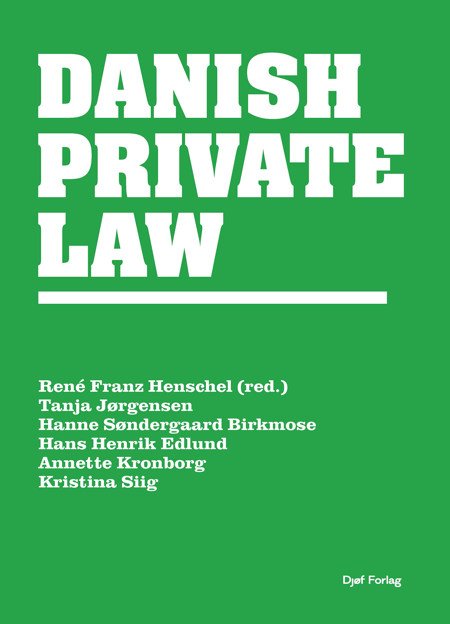
    Cover til: Danish Private Law (1. udg.)

    1. udgave

    19. februar 2026

    • e-ISBN: 9788757469080
    • p-ISBN: 9788757469073
    • Antal sider: 350
    • Bogtype: Lærebog

    Emner

    • Arveret,
    • Familieret,
    • Insolvensret,
    • Obligationsret

    Danish Private Law is an abridged English-language edition of the classic textbook Dansk privatret (23rd edition, published in 2024).

    This English edition has been prepared primarily as a teaching resource for English-language courses in business law at universities and other institutions of higher education.

    • Bøger
    • /
      Cover af Danish Private Law
      Danish Private Law
    • / 1. udg. 2026

    Danish Private Law (1. udg.)

    1. udgave - 19. februar 2026

    Af Tanja Jørgensen , Hanne Søndergaard Birkmose , Hans Henrik Edlund , Annette Kronborg og Kristina Siig

    René Franz Henschel (red.)

    Cover af Danish Private Law (1. udg.)

    Denne bog er ikke tilgængelig

    Du kan fortsat få adgang til bogen, ved at abonnere på Jurabibliotek.

    Har du allerede købt adgang? Log ind her